
Most bikes and tools are not taken from behind a forced lock. They go from the carport, the side passage, the open trailer, the verandah, the spot beside the back step where the mower lives. The lock was never the problem, because there wasn’t one.
So the first job is not choosing a padlock. It’s working out where these things sit when nobody is watching them, then putting each one behind something that takes real effort to get through. That usually means a shed or garage with a proper door lock, a gate that can be locked, and a fixed anchor point for anything on wheels.
Here’s how to sort it, and what the NSW numbers say about where the risk sits right now.
What the NSW Figures Say
Break-ins are not the growth story. In the two years to March 2026, the NSW Bureau of Crime Statistics and Research recorded break and enter dwelling, break and enter non-dwelling and motor vehicle theft as all stable across the state.
What did rise was other stealing offences, up 3.1 per cent. That category covers theft where nobody forced entry, and the biggest single driver was bikes. Theft of motorised bicycles climbed 27 per cent over two years, from 1,644 to 2,080 incidents in the year to March 2026. That one item accounted for more than a third of the whole increase in other stealing offences where a stolen item was recorded.
Read those two facts together and the message is clear. Forced entry isn’t getting worse. Opportunistic theft of expensive, portable, unsecured items is.
One honest caveat before anyone panics. That rise was concentrated in Greater Sydney. Across Regional NSW, which includes Newcastle and Lake Macquarie, other stealing offences were stable. The trend is worth acting on because e-bikes here cost the same as e-bikes in Bondi, but the local numbers are not climbing.
Tradies should also note copper theft rose 16.3 per cent over the same period. If you leave offcuts or cable on a ute tray or an open trailer, that’s now a target in its own right.
Start With Where It Sits, Not What Lock to Buy
Walk the property once, in the evening, and write down every bike, mower, whipper snipper, generator, toolbox and power tool, plus exactly where it spends the night.
Most people find two or three items with no lock between them and the street. A bike leaned against the side of the house. A toolbox left in a ute tray. A mower under the carport because the shed is full.
Those are your problems, and none of them are solved by buying a better padlock for the shed. They’re solved by making room, or by giving that item its own secure spot.
The Gate Everyone Forgets
If a bike lives in the backyard, the side gate is your first lock, not your last.
A gate that latches but doesn’t lock is a gate that opens. A bolt with a padlock through it stops the casual walk-in, which is the exact behaviour driving those stealing figures. Fit the bolt so the fixings can’t be undone from the street side, and use a padlock with a shrouded shackle so bolt cutters can’t get a bite.
It takes twenty minutes and it changes the risk profile of everything behind it.
Match the Lock to the Door It’s Bolted To
This is where most outdoor security goes wrong. People buy a good padlock and fit it to a door that can be levered off its hinges, or bolt a hasp through thin sheet metal with short screws.
A padlock is only ever as strong as the hasp, and the hasp is only as strong as what it’s fixed to. If the door is light Colorbond or thin ply, the lock will not be the thing that fails. Our shed security guide covers hinges, hasps and fixings in detail.
On a solid timber or metal door sitting in a proper frame, you have a better option. A deadlock throws a solid bolt straight into the door frame, and because that bolt has no spring behind it, it can’t be shimmed or forced back the way a spring latch can. Nothing sits exposed on the outside for someone to attack with a bar or a set of cutters.
That makes a deadlock the right choice for a garage personal access door, a workshop, a lock-up or an under-house storage room. Our guide to choosing and fitting deadlocks covers single cylinder versus double cylinder and what suits each door type.
For the roller door itself, and for the door between the garage and the house, we’ve written that up separately.
Anchor the Bike, Not Just the Door
A bike inside a locked shed is still a bike that can be carried out in one movement if someone gets the door open.
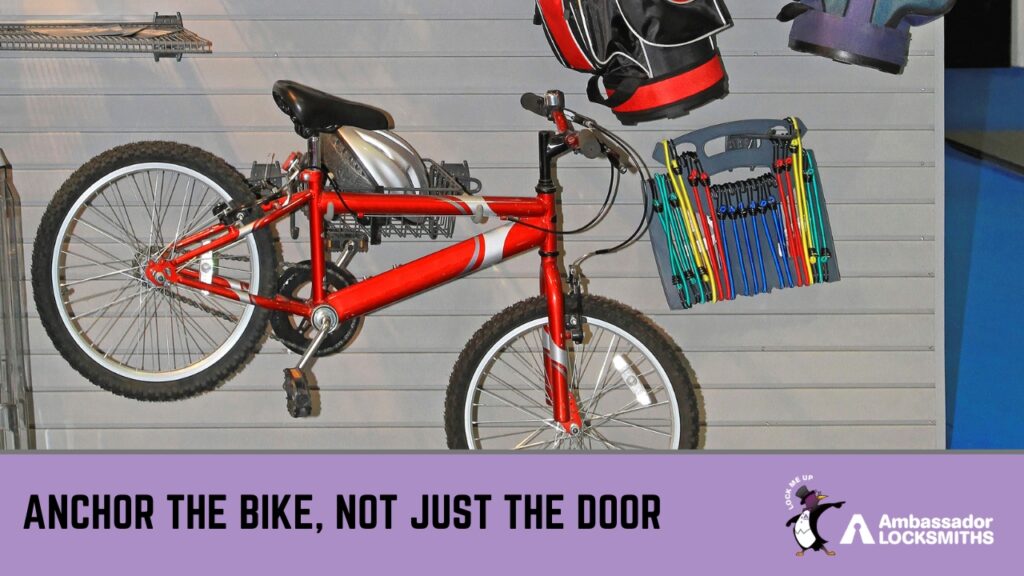
A ground or wall anchor bolted into concrete or a masonry wall fixes that. Lock the frame to the anchor, not just a wheel, and use a hardened chain or a solid D-lock rather than a cable. Cables are for keeping honest people honest, and they part in seconds under decent cutters.
The same principle applies to the expensive one-off items. Generators, compressors and pressure washers are worth chaining to something fixed once they’re inside.
Write Down the Serial Numbers Today
This is the ten-minute job people skip and then regret.
Photograph each bike and each significant power tool, and record the serial number. For a bike, that’s usually stamped underneath the bottom bracket where the pedal cranks meet the frame. Keep the list somewhere off the property, in your email or a cloud folder.
Without a serial number, recovered property generally cannot be matched back to you, and insurance claims get slower and harder. With one, a bike that turns up in a police storage yard has a chance of coming home.
While the list is open, check what your contents policy says about bicycles and about items stored in an outbuilding. Most policies treat those differently to what’s inside the house, and some apply a separate limit.
A Weekend’s Worth of Jobs
Fit a lockable bolt to the side gate. Clear enough shed space that nothing valuable sleeps outside. Replace any hasp fixed with short screws, using coach bolts through the door instead. Fit a deadlock to any solid door protecting tools. Bolt down an anchor point for the bikes. Photograph everything and file the serial numbers.
None of that is a big job. Working through it costs a Saturday, and it puts a real barrier in front of the theft that is rising.
Get It Sorted Properly in Newcastle and Lake Macquarie
If you want the locks specified and fitted so they hold, we can look at the doors you’ve got and tell you honestly which ones are worth upgrading and which are fine as they are.
Call Ambassador Locksmiths on (02) 4942 2202 or 0407 452 424, or get in touch through our contact page.