

A deadlock needs a deliberate turn of a key or thumb turn and gives you the stronger barrier against forced entry. A deadlatch locks itself the moment the door shuts, which is the more convenient option day to day. Most Newcastle and Lake Macquarie homes are best served by both, fitted to the same door.
One thing to clear up first. In Australia, a deadlock and a deadbolt are the same thing. Deadlock is the term you will hear from locksmiths, tradespeople and insurers here, while deadbolt is more common overseas. This guide uses both.
The Short Comparison
| Factor | Deadlock (deadbolt) | Deadlatch |
| How it locks | Manually, by key or thumb turn | Automatically, when the door closes |
| Resistance to forced entry | High. Solid bolt with no spring to compress | Moderate. Spring latch held by a guardbolt |
| Getting out in a hurry | Fast with single cylinder. Slower with double cylinder | Fast. No key needed from inside |
| Risk of leaving it unlocked | Present. You have to remember | Very low. It locks itself |
| Typical insurer position | Usually accepted where the policy specifies deadlocks | Often not sufficient on its own |
| Allowed on units and apartments | No. Not permitted on home unit entry doors | Yes, where the inside knob unlocks automatically |
| Supply and install, NSW | Around $150 to $300 per door | Around $150 to $300 per door |
| Best suited to | Front and back doors, homes empty for long stretches | Busy households, rentals, doors in constant use |
Prices are indicative for NSW in 2026 and cover supply and install during business hours. After-hours work typically runs one and a half to two times the standard rate.
With more than 15 years fitting and servicing locks across the region, Ambassador Locksmiths has installed both types on every kind of door and frame the Hunter throws at us. What follows comes out of that work.
How to Tell Which Lock You Already Have
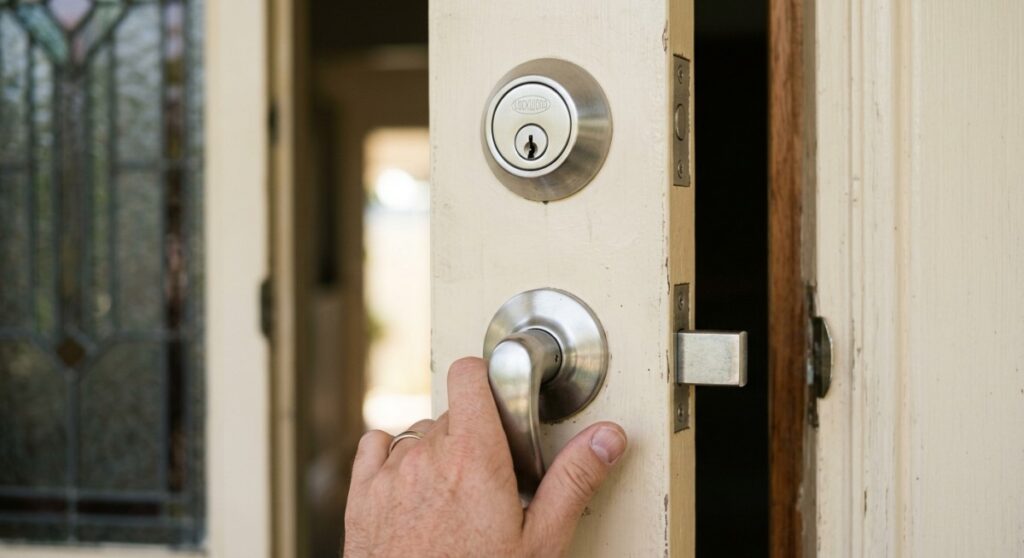
Before you decide what to buy, it helps to know what is on your door now. Open the door and look at the edge where the bolt sits.
You have a deadlatch if: the bolt is angled on one face and springs back when you press it with a finger. Beside it sits a smaller second bolt called a guardbolt. The other giveaway is behaviour. If the door locks itself when you pull it closed, it is a deadlatch.
You have a deadlock if: the bolt is square-ended and will not budge under finger pressure. It only moves when you turn the key or the thumb turn.
You may have both. Plenty of homes run a deadlatch as the everyday lock with a deadlock fitted above or below it. The two sit at different heights on the door edge and work independently.
What a Deadlock Does
A deadlock throws a solid bolt into the door frame, and it only moves when someone deliberately turns a key or a thumb turn. There is no spring, which is what stops it being pushed back with a card, a shim or steady pressure on the door.
The main types
Single cylinder deadlocks are the standard choice for homes. Key on the outside, thumb turn on the inside, so you can get out quickly without hunting for a key. The catch is glass. If your door has a panel near the lock, someone can break it and reach the thumb turn.
Double cylinder deadlocks take a key on both sides, which closes off the glass-panel weakness. It also means everyone in the house has to know where the inside key lives. More on the safety trade-off below.
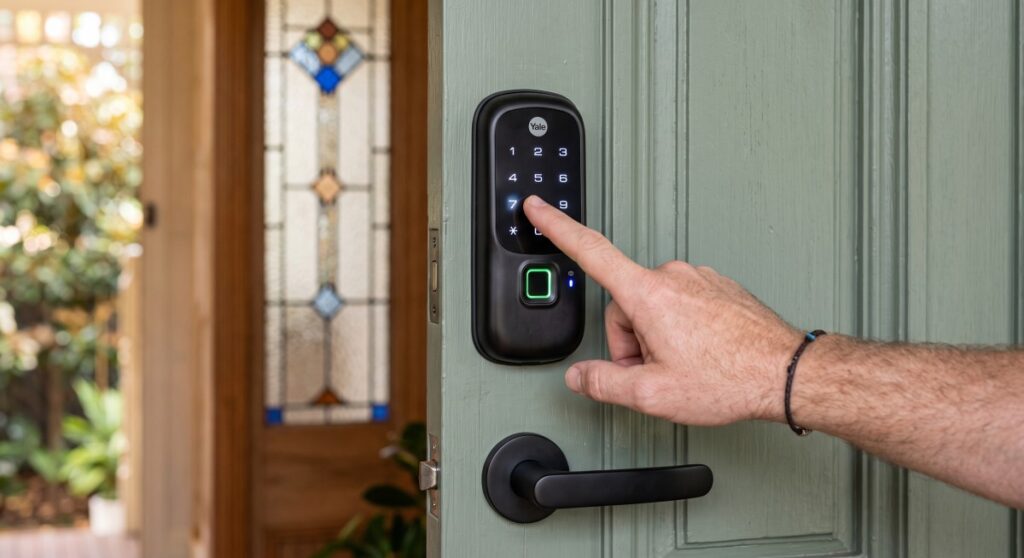
Keyless and electronic deadlocks swap the outside cylinder for a keypad, and many pair with a phone app. They suit households where keys move around a lot, such as families with teenagers or homes with regular trades access. Since 4 March 2026, connected smart locks sold here also have to meet the Commonwealth cyber security rules covered further down.
Vertical deadlocks throw into a channel in the frame rather than a flat strike plate, so they hold up better against prying. Worth the upgrade on doors that open onto a footpath, a laneway or anywhere out of sight.
Rim deadlocks mount on the surface of the door rather than inside the edge. They are quicker to fit but easier to lever off than a mortice-set deadlock, so they belong on secondary doors rather than a main entry.
The deadlocks we stock and install cover the residential and commercial grades of each of these.
What a Deadlatch Does
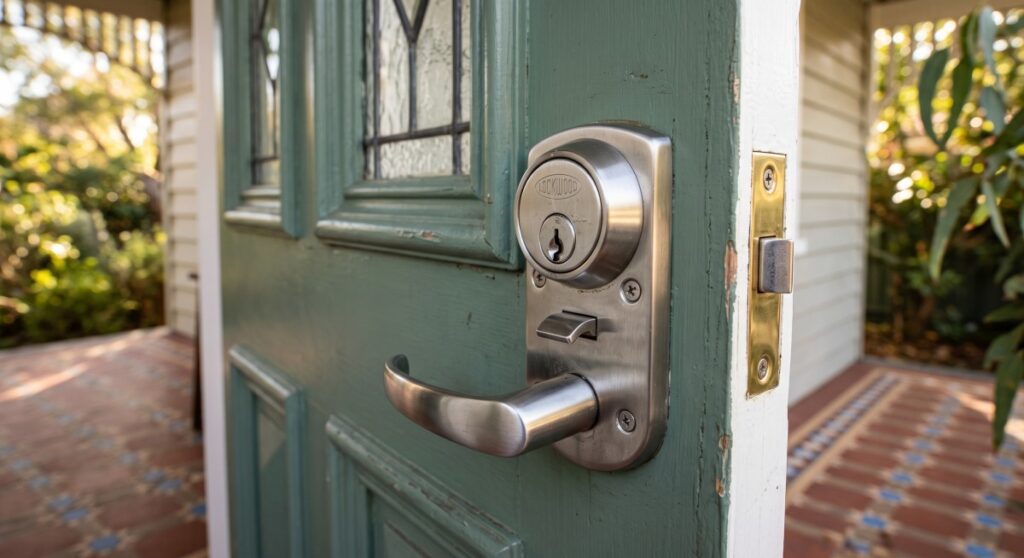
A deadlatch secures the door the instant it closes. It uses a spring-loaded latch bolt paired with a guardbolt. When the door shuts properly, the guardbolt lands on the strike plate and locks the latch bolt in place, so it cannot be slipped with a card or a thin blade.
The automatic action is the whole point. There is no step to remember. Closed means locked.
The main types
Bored deadlatch. Fitted by drilling a round hole through the face of the door plus a smaller hole for the latch. Thumb turn inside, key outside. It is the most common deadlatch in homes because it is straightforward to fit and the hardware is easy to get.
Mortice deadlatch. Fitted into a rectangular cavity routed into the door edge, so the lock body is protected by the door itself on most sides. Better tamper resistance and better durability, which is why it is the pick for doors that get heavy use.
Two related mechanisms often get confused with deadlatches, so it is worth naming them. A spring latch is a plain spring-loaded bolt with no guardbolt, which means it can be slipped with a card. It belongs on internal doors only. A roller latch uses a cylindrical roller instead of a bolt and is a light-duty fitting for cabinets and similar. Neither is a security lock.
The deadlatches we supply include bored and mortice options sized for standard Australian residential doors.
Where Each One Wins
Security
A deadlock gives you the stronger barrier. No spring means the bolt cannot be compressed by leaning on the door or working a flexible tool into the gap. On a main entry door, that is the more robust option.
A deadlatch is solid too, but it depends on the guardbolt landing cleanly on the strike plate. If the door has dropped or the frame has moved, the guardbolt may not engage, and the latch becomes slippable. Misaligned strike plates are one of the more common faults we find when a deadlatch has been bypassed, and the fix is usually alignment rather than a new lock.
Convenience
A deadlatch takes the remembering out of it. That counts for a lot in a house with kids, older residents, or anyone regularly leaving with their hands full.
A deadlock gives you certainty instead. You know it is locked because you locked it.
Getting out in an emergency
A single cylinder deadlock is fine here. The inside thumb turn opens it without a key. A deadlatch opens from the inside without a key as well.
A double cylinder deadlock is the one to think carefully about, because it needs a key from the inside. The rules and the practical advice are set out in the next section.
Durability and fitting
Hardened steel or solid brass deadlocks are among the longest-lasting locks you can buy. A mortice deadlatch is comparable when it goes into a sound door edge, though the routing has to be right or you weaken the door.
Either way, the fitting matters as much as the lock. A deadlock that does not throw fully into a reinforced strike plate, or a deadlatch with a guardbolt that misses, gives you a fraction of the protection you paid for.
What this Means in Australia
Australian Standard AS 4145
AS 4145 is the Australian Standard series covering locksets and hardware for doors and windows. The part that matters for a home lock is AS 4145.2, which sets out how mechanical locksets and latchsets are designed and tested for resistance to forced entry and for wear under everyday use. It covers timber, glass and metal doors in homes and businesses alike.
The standard was developed by a committee that included the Master Locksmiths Association of Australasia, the Housing Industry Association and the NSW Police Force, which is a reasonable signal of who it was written to protect.
For a buyer, the useful part is the rating system. A lock is graded separately on four measures, and the grades appear on the spec sheet as a short code:
- SL, security level. Resistance to forced entry, drilling, sawing and picking. SL8 is the top grade.
- D, durability. How many operating cycles the lock survives in testing. D8 represents 500,000 cycles.
- C, corrosion. Salt spray hours, which matters more than most people expect on a coastal door in Newcastle.
- K, key security. The number of key combinations and how well the key is protected against unauthorised copying. Restricted keying systems sit at the top.
There is no single pass mark for a home. The point is that a lock carrying an AS 4145.2 rating has been independently tested, and one that states no rating at all has not. If a product does not publish its grades, treat that as a reason to ask.
One thing the standard does not do is settle the egress question. Locks for fire doors, exit doors and emergency exits are subject to separate requirements under the building rules, which is the next section.
Does Your Insurance Require Deadlocks?
Deadlocks on all external doors are close to a baseline expectation among Australian insurers for burglary and theft cover on a home policy. Some insurers set additional conditions at higher sums insured. GIO, for example, has required deadlocks or deadbolts on every external door, including sliding and French doors, once a building is insured above a certain value, with more required again at higher values.
Deadlocks also cut the other way in your favour. ASIC’s Moneysmart notes that insurers commonly offer a premium discount where deadlocks, smoke alarms or a security system are fitted, so the lock can pay for part of itself over time.
Two things worth knowing. A deadlatch on its own often does not satisfy a policy that specifies deadlocks. And the requirement usually extends to every external door, not only the front one, which is why doing the lot in one visit works out cheaper than coming back door by door.
Wording varies between insurers and between policies from the same insurer, so the only reliable answer is in your own product disclosure statement. We are locksmiths rather than insurance advisers, so check your policy or ring your insurer before relying on this.
Double Cylinder Deadlocks and Getting Out in a Fire
This is the question we get asked most, and the answer depends on whether you live in a house or a unit.
In a standalone house. The emergency egress provisions in the building rules apply to required exits in apartment blocks and commercial buildings, not to a private house. Double cylinder deadlocks are legal and widely fitted in Australian homes. That said, legal is not the same as safe. Industry and fire safety bodies have been pointing out the gap for years: a lock that needs a key from the inside can trap people during a fire, and the rules simply have not caught up.
In a unit or apartment. The position is different and stricter. A home unit entry door must use a deadlatch that automatically unlocks the inside knob when the door is opened by key from outside. Deadbolts are not permitted on home unit doors. Any door forming part of a required exit or the path of travel to one must open from the inside without a key, using a single-handed downward lever action or a push, with the device between 900 mm and 1.1 m from the floor. A knob or turn snib does not satisfy that, and neither does a double cylinder lock.
There is a further catch in NSW strata buildings. The apartment entry door is usually common property, not yours, so adding or changing a lock generally needs owners corporation approval. Fitting an extra deadlock to a fire-rated entry door can also breach fire safety regulations and put the building’s annual fire safety statement at risk.
Practical advice, whatever your building type: if you fit a double cylinder deadlock, keep a dedicated key on a hook within arm’s reach of the door on the inside, make sure every adult in the house knows where it is, and never keep the only copy in a bag or a pocket. A key you cannot find in the dark is the same as no key.
Smart and keyless locks: the 2026 rules
If you are considering a keypad or app-controlled deadlock, there is a new layer to be aware of. The Cyber Security (Security Standards for Smart Devices) Rules 2025 commenced on 4 March 2026 after a twelve-month transition, and they apply to most connected consumer devices manufactured from that date, smart locks included.
The three obligations that matter to a buyer are straightforward. Devices can no longer ship with a shared factory default password. Manufacturers must publish a way to report security vulnerabilities. And they must state how long the device will receive security updates, including an end date.
That last one is the one people overlook. A smart lock with an update end date two years away is a different purchase from one supported for ten. Ask for the support period before you buy, and remember the mechanical bolt and the electronics are rated separately. A lock can carry a strong AS 4145.2 grade on its bolt and still have weak electronics behind it.
What it costs around Newcastle
Supply and install for a standard residential deadlock generally runs around $150 to $300 per door in NSW, including the hardware. A call-out during business hours typically adds $80 to $120. After-hours and weekend work runs roughly one and a half to two times the standard rate, so it is worth booking ahead rather than waiting for a problem.
What moves the price is the grade of lock, the door material and whether the edge needs preparing. A replacement into an existing mortice is the cheapest job on the list. A new deadlock into an unprepared door takes longer because the door has to be cut. Timber doors are usually straightforward. Aluminium, steel and glass doors take more time and more specialised tooling. Hollow core doors often need reinforcing before a deadlock can be fitted at all.
Doing the whole house at once is the better value. Fitting out a typical three-bedroom home generally lands somewhere between $300 and $700 depending on the number of doors and the hardware chosen, and you only pay one call-out. If your insurer wants deadlocks on every external door, ask about keying them alike so the lot runs off a single key.
These are indicative 2026 figures rather than a quote. Ring us for a fixed price on your doors.
Running both locks together
Plenty of homes here use a deadlatch as the everyday lock and a deadlock as the second layer on the same door. The deadlatch keeps the door secure without anyone having to think about it, and the deadlock goes on overnight and whenever the house is empty for a stretch.
If a two-lock installation is awkward on your door, single and double block locks combine multiple locking points into one unit and are worth a look.
Which should you choose?
- Worried about forced entry? A deadlock, ideally a mortice-set one, gives you the strongest resistance.
- Want it to look after itself? A bored or mortice deadlatch locks automatically with nothing to remember.
- Glass panel near the lock? A double cylinder deadlock closes that gap, as long as you keep a key accessible inside.
- Living in a unit or apartment? You need a compliant deadlatch, not a deadbolt, and you will need owners corporation approval before anything changes.
- Young kids or elderly residents at home? Do not rely on a double cylinder deadlock as the only lock. A single cylinder deadlock or a deadlatch is the safer fit.
- Insurer specifies deadlocks? You need deadlocks on the external doors. A deadlatch alone will not tick that box.
- Want the lot? Fit both. Deadlatch for the everyday, deadlock for the extra layer.
Not sure which one your door needs?We fit deadlocks and deadlatches across Newcastle, Lake Macquarie and the surrounding suburbs, and we will tell you honestly if the lock you have is fine as it is. Call 0407 452 424 or (02) 4942 2202, or read more about lock installation, changes and repairs.
Common Questions
Can a deadlatch be picked?
Any pin tumbler lock can be picked with the right tools and enough time, and a deadlatch is no exception. In practice, picking is rare in residential break-ins because it is slow and takes skill. Forcing the door or breaking glass is far more common, which is why the strength of the bolt and the strike plate matters more than the pick resistance of the cylinder.
Can you lock a deadlock from the outside without a key?
No, and that is the design working as intended. A deadlock only moves when someone turns a key or the inside thumb turn. If you want a door that locks behind you as you go, that is what a deadlatch does.
Is a nightlatch the same as a deadlatch?
They overlap. A nightlatch is a surface-mounted lock that latches automatically when the door closes, and better models include a deadlocking function on the latch, which makes them a type of deadlatch. Cheaper nightlatches without that function can be slipped with a card. If you have a nightlatch, check whether the latch deadlocks.
Can a deadlock be rekeyed, or do I need a new one?
Most quality deadlocks can be rekeyed, which means changing the pins so old keys stop working while the lock stays on the door. It is usually cheaper than replacing and it is the standard fix after losing a key or moving into a new place. Very cheap or badly worn locks are sometimes not worth rekeying, and we will tell you which situation you are in.
About Ambassador Locksmiths
Ambassador Locksmiths is a family-run business that has been securing homes across Newcastle and Lake Macquarie since 2000. The team are fully licensed and insured, and handle installation, repairs and rekeying for deadlocks, deadlatches and electronic locks. If you are not sure what suits your door, get in touch and we will take a look.
Published 19 October 2018. Last updated 11 September 2026.